White-matter alterations in right-hemispheric language pathways in deaf signers
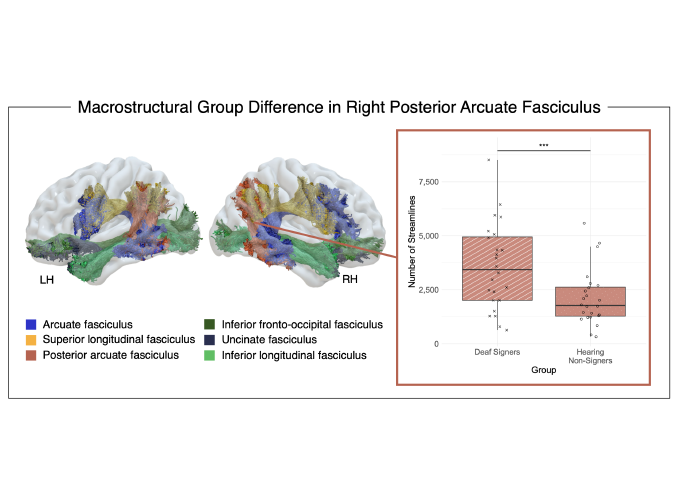 Illustration under a Creative Commons license.
White-matter alterations in right-hemispheric language pathways in deaf signers
Resumen
Language processing relies on a distributed network of white-matter pathways connecting frontal, temporal, and parietal regions of cortex. While the arcuate fasciculus in the left hemisphere connecting the posterior inferior frontal gyrus to the posterior temporal cortex is considered universal across languages and modalities (i.e., spoken vs. signed), little is known about how other language-related pathways in both hemispheres adapt in deaf individuals who use a sign language. Here, we used diffusion-weighted MRI to characterize the macro- and microstructural properties of fiber pathways in the core and extended language network in 24 early deaf signers and a control group of 24 hearing non-signers. Automated fiber quantification revealed no macrostructural group differences in left-hemispheric pathways, including the canonical left arcuate fasciculus. In contrast, deaf signers manifested increased streamline counts in the right posterior arcuate fasciculus connecting posterior temporal and parietal regions. Moreover, microstructural group differences were observed in several right-hemispheric tracts, including the right arcuate and right superior longitudinal fasciculus, as well as bilateral uncinate fasciculus. These data suggest that most language-relevant left-hemispheric pathways develop in a similar fashion regardless of the modality of language use, while several right-hemispheric tracts exhibit structural alterations potentially reflecting modality-specific processing demands associated with sign language. In sum, our findings highlight the crucial role that right-hemispheric structures play in processing a visuo-spatial language and, at the same time, indicate that the typical development of left-hemispheric language-relevant pathways does not depend on acquiring and using a spoken language.